Electronic Displacement in a covalent bond

Permanent Dipole

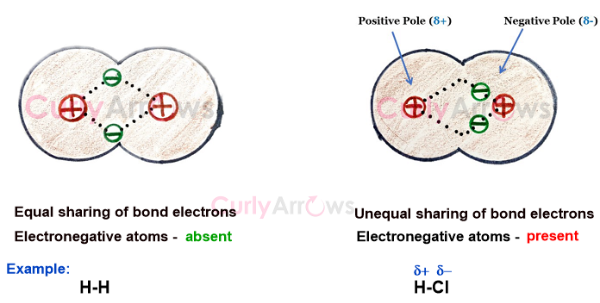
A permanent dipole is an inherent feature of the molecule due to the nature of the participating atoms forming the two-electron covalent bond.

Some atoms withdraw more of the bond electrons towards themselves, increasing their electron density and leaving the other end electron deficient. This unequal electron charge distribution creates positive and negative poles (denoted with δ+, δ- signs), causing the molecule to have permanent poles or a dipole.


Dipole

The redistribution of electrons in an atom, bond, or molecule creates two ends (or poles), one electron-rich negative and the other electron-deficient positive; such an atom, bond, or molecule is said to have a dipole (two poles).


What is a dipole in chemistry


Difference between Inductive and Resonance Effect

Two electron displacement effects in a covalent bond framework: one polarises sigma bonds along a chain, the other relocates pi electrons through conjugation.

Inductive Effect (-I, +I)
Inductive effect: arrow representation showing electron density pulled along sigma bonds toward an electronegative atom.

Through sigma bonds. Sigma electrons polarise toward the electronegative atom.

The bond electrons stay in place; only their density shifts. Diminishes rapidly with each bond away from the electronegative source. Permanent.

Resonance effect (-R, +R)
Resonance effect: pi electrons delocalised across a conjugated system through p-orbital overlap.

Through pi conjugation. Pi electrons relocate through the conjugated system.

Electrons move position via overlapping p-orbitals. Transmits across the whole conjugated framework without strong distance decay. Permanent.

i. Which electrons move, sigma vs pi

Inductive Effect (-I, +I)

The sigma (σ) or covalent bond electrons are pulled or pushed so that the electron density shifts toward the most electronegative atom.

Resonance effect (-R, +R)

The pi (π) electrons are pulled and pushed through the p-orbitals along the sigma (covalent) bond framework.

ii. Nature of the shift, polarisation vs relocation

Inductive Effect (-I, +I)

The sigma bond electrons do not change their positions. They are only polarised. The bond stays where it is; the electron density along it gets pulled toward one end.

δ+ δ+ δ+ δ+C4H3δ+ δ+ δ+C3H2δ+ δ+C2H2δ+C1H2δ−NO2

Resonance effect (-R, +R)

The π electrons change their positions along a conjugated system. The nonbonding electrons, when conjugated, are also involved in resonance.

iii. Permanence of inductive and resonance effects

Inductive Effect (-I, +I)

It is a permanent effect. The polarisation persists as long as the electronegative substituent is part of the molecule.

Resonance effect (-R, +R)

It is a permanent effect. The delocalisation persists wherever conjugation is maintained through overlapping p-orbitals.

iv. Plus-minus classification of +I, −I, +R, −R

Inductive Effect (-I, +I)

Categorised as negative (−I) and positive (+I) inductive effects. The inductive effect is positive when the substituent is an electron-donating group and negative when the substituent is an electron-withdrawing group.

Resonance effect (-R, +R)

Categorised as negative (−R/−M) and positive (+R/+M) resonance effects. The resonance effect is positive when the substituent is an electron-donating group and negative when the substituent is an electron-withdrawing group.

v. Electron-withdrawing example, the nitro group

Inductive Effect (-I, +I)

−NO2 attached through a sigma bond is electron-withdrawing (−I). The nitrogen pulls sigma electron density along the chain back toward itself.

Resonance effect (-R, +R)

−NO2 attached to a benzene ring is also electron-withdrawing (−R). The pi electrons of the ring delocalise into the nitro group's pi system, draining electron density from the ring.

vi. Electron-donating example, alkyl and amino groups

Inductive Effect (-I, +I)

−CH3 attached through a sigma bond is electron-donating (+I). The methyl group's electron density is pushed along the sigma framework toward the rest of the molecule.

Resonance effect (-R, +R)

−OH attached to a benzene ring is electron-donating (+R). The oxygen's lone pair delocalises into the pi system of the ring, raising electron density on the ring.

vii. Range, sigma chain decay vs pi conjugation reach

Inductive Effect (-I, +I)

Decays rapidly with distance. Each successive sigma bond carries less of the polarisation, shown by the diminishing δ+ symbols above. Beyond three or four bonds, the effect becomes negligible.

Resonance effect (-R, +R)

Transmits through the whole conjugated system. As long as the p-orbital chain is unbroken, the resonance effect reaches every position the conjugation touches, regardless of how many atoms apart they are.

Quick check

A hydroxyl group (−OH) is attached directly to a benzene ring. Which effect dominates in determining how it influences the ring's electron density?

Try again
Read the full explanation Hide full explanation

Understanding the inductive and resonance effects in detail

Two ways electrons shift in a covalent bond framework

The inductive and resonance effects are the two permanent ways electron density can be displaced inside a covalent molecule. Both are responses to electronegativity differences and to the structural arrangement of bonds, but they operate through different bond types and at different ranges. The inductive effect runs through sigma bonds; the resonance effect runs through the pi system and conjugated lone pairs. The two effects often coexist in the same molecule and can either reinforce or oppose each other.

Reached the end of the full explanation.

What is the order of the +I effect?

The +I effect is an electron-donating (or an electron-pushing) inductive effect by an atom or group of atoms relative to Hydrogen. It means that a +I group like methyl (-CH3) will push electrons away from itself more than the hydrogen atom would if it occupied the exact position in the molecule.

The push of electrons is represented with an arrow over the bond, (>) indicating the direction of the electron flow.


Electronegativity

Electronegativity measures on a scale of 0.8 – 4 an atom’s or group of atoms’ tendency to attract the bond electron pair towards itself, thereby creating partial negative (δ-) and positive (δ+) terminals.


Definition of electronegativity


Inductive Effect

An atom or group of atoms that can pull the bond electrons towards itself or push the bond electrons from itself and decreasingly transmit the effect along the sigma (σ) bonds of the carbon chain inducing permanent polarization in the molecule. Such an effect is called the Inductive effect.


Resonance

Resonance theory explains various observed properties in a molecule using the electron delocalization concept and multiple Lewis structures, which a single Lewis structure cannot.

A single Lewis structure can only describe some but not all of a molecule's observed properties. Resonance theory is helpful in molecules that can be expressed using several Lewis structures, like Benzene or CO2

What is Electronegativity?

Sharing resources is essential to build a harmonious world. When the resources are shared ineffectively conflicts emerges. A similar principle extends to Chemistry. 

Atoms are in a state of harmony when the neighbouring atoms shares electrons. When the sharing stops, Chemical reactions triggers.

The imbalance in sharing electrons influences the molecule’s polarity, reactivity, and physical properties. The disagreement on sharing is brought about by electronegativity.